
Introduction
The connecting rod is a critical component in internal combustion engines, playing a pivotal role in transferring the reciprocating motion of the piston to the rotational motion of the crankshaft. This component transmits the force and energy generated from combustion in the cylinder to the crankshaft, enabling the conversion into rotational torque to drive the vehicle. Operating under high dynamic loads and intense mechanical stresses, the connecting rod is constructed from robust materials such as forged steel or lightweight alloys to ensure strength, durability, and precise performance. Precise and balanced design, combined with advanced machining, minimizes unwanted vibrations and optimizes engine efficiency.
Material Selection
To meet these demands, high-performance materials such as 4340 forged steel or micro-alloyed steels are selected due to their excellent strength-to-weight ratio and fatigue endurance. For specific applications where weight is a concern, aluminum alloys or titanium rods may be used, though at higher cost. At Noor Powertrain, we ensure material equivalency through meticulous reverse engineering and analysis, selecting materials that match or exceed the mechanical properties of the original part while remaining compatible with our manufacturing process.
Redesign & Manufacturing
The production of connecting rods begins with precise reverse engineering, utilizing 3D scanning and enhanced CAD modeling. After finalizing the digital model and generating manufacturing drawings, including tolerances and GD&T, the process continues based on application, production volume, and performance requirements. The most common method is forging, where steel billets (such as 4340) are used. Forged blanks are then subjected to heat treatment (typically Q&T) to optimize hardness and toughness. This method, known for its high strength, optimal grain alignment, and extended fatigue life, is ideal for high-performance engines and heavy-duty vehicles.
Another method, powder metallurgy, involves compacting metal powder (usually steel) in precise molds and sintering at high temperatures. It often employs fracture splitting for accurate rod and cap connection, making it cost-effective and low-waste for high-volume production of standard vehicles, though it may be less robust than forging for heavy-duty applications.
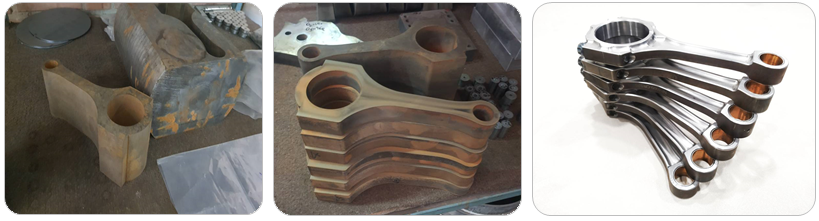
Machining from billet involves shaping the connecting rod from a solid metal block (typically steel or aluminum) using CNC machines or, in specific cases, wire-cut methods. This approach offers high precision and is suitable for prototyping or low-volume production but is costly, time-consuming, and less strong than forging due to the lack of grain alignment. Lastly, casting involves pouring molten metal into molds, which is less expensive but offers lower strength and fatigue resistance, making it suitable for lower-performance engines or specific applications.
Precision Machining
After heat treatment, the connecting rod undergoes several stages of CNC machining to meet exact dimensional and geometrical tolerances. Key machining operations include boring the small and big end bores, creating oil holes, and performing fracture-splitting (for powder-forged rods) or cap-matching (for traditional rods). The surfaces are then honed for precise bearing fit and fatigue resistance. We also perform weight-matching of rods in engine sets to ensure balance between cylinders, reducing vibration and uneven wear. Optional surface treatments like shot peening are used to enhance fatigue strength by inducing compressive residual stresses.
Quality Control
To ensure the final product meets global standards, each connecting rod is subject to comprehensive inspection. This includes CMM measurements to verify tolerances, ultrasonic or magnetic particle testing for internal and surface defects, and hardness testing to confirm heat treatment effectiveness. Every rod batch is also statistically analyzed to ensure consistency and reliability.
Conclusion
The connecting rod manufacturing process at Noor Powertrain combines advanced engineering design, precision forging, and state-of-the-art machining with rigorous quality control. Our ability to redesign and localize critical engine components, supported by robust material selection and reverse engineering, positions us as a trusted supplier of high-performance powertrain solutions for the automotive industry.
